Follow the money
Public money, private contracts, primary documents. When public money goes into private hands, what does the public get back?
Two strands run through my research: the Private Finance Initiative in the NHS, and the contracts NHS England signed with the private hospital sector during the pandemic. Both ask the same question, and both use the same method — obtain the primary documents, usually under the Freedom of Information Act, and read them properly.
PFI
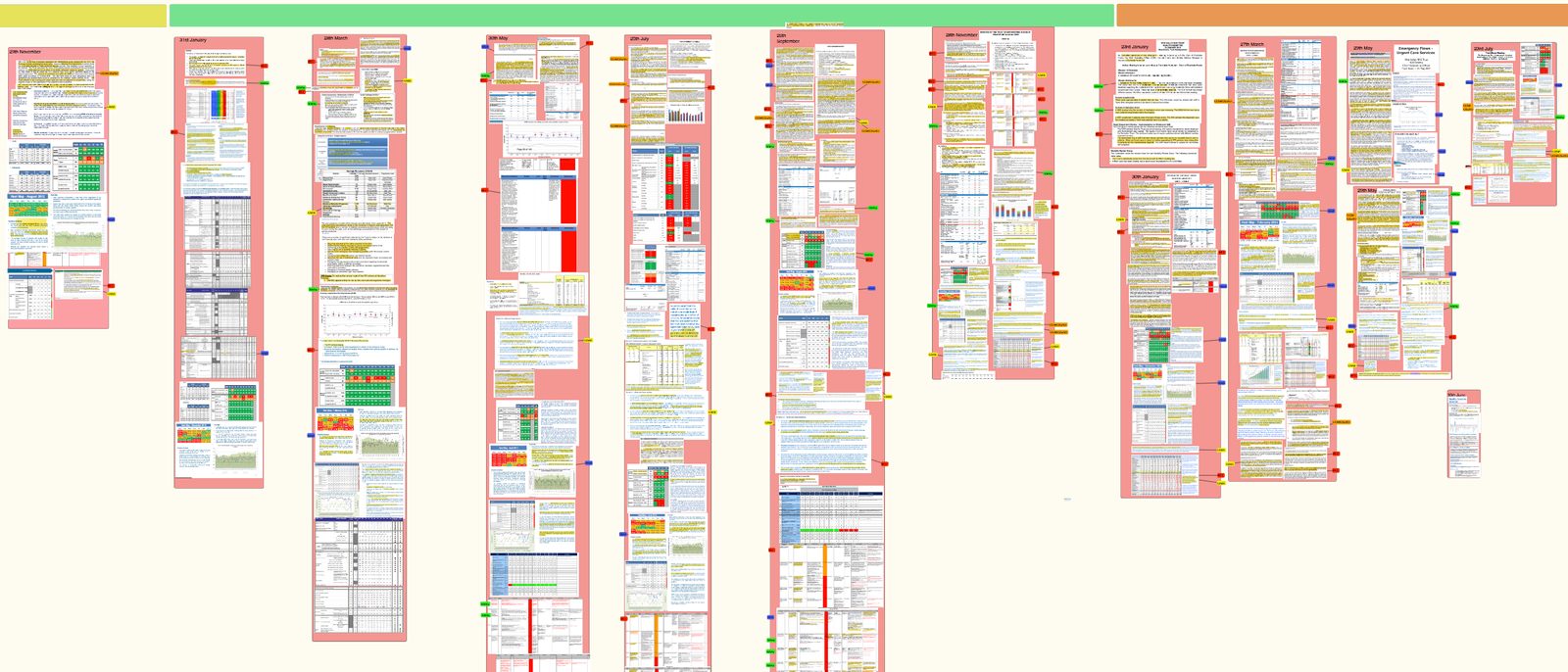
PFI timeline — the investigative board, the case file at a glance
This started as a university dissertation. My mother sent me a story from the local paper: Hereford County Hospital — where both my parents worked — had failed a fire safety test. I wanted to know why. Nobody at the Trust or its PFI consortium would talk, so I started asking questions under FOI, and a student project became an eighteen-month legal battle over the 4,500-page contract between Wye Valley NHS Trust and Mercia Healthcare.
What the documents showed: a £75m hospital that will cost the Trust £257m by the time the contract ends in 2029; an affordability case decided on a 0.6% margin; and a fire safety dispute that ended with the Trust recovering £3.5m — no damages, and its right to pursue the case in court signed away.
Profit Before Patients
The full story of the Hereford PFI — how the deal was signed, what it cost, and how the fire safety dispute was settled behind closed doors. Long-form, hosted here.
The supporting evidence is an archive of eighteen FOI cases (PFI01–PFI18): contract requests to NHS trusts in Bristol, Coventry, Derby and Hereford, and oversight correspondence prised out of the Department of Health, HM Treasury and the regulators. The tribunal cases that forced much of it into the open are on the FOI page.
COVID private-hospital contracts
The other major strand of my work has been on private sector contracting in the NHS, in particular the £2bn+ deal between NHS England and the private hospital sector during COVID. This blank-cheque deal saw government paying the entire operating costs for the sector for the best part of a year, even as private patients were being prioritised over assisting swamped NHS services.
In March 2020, NHS England bought practically the entire private hospital sector — 26 companies — agreeing to cover their operating costs in return for access to their beds, staff and equipment. I co-wrote two reports for the Centre for Health and the Public Interest (CHPI) examining what the public got for that money.
For Whose Benefit? NHS England’s contract with the private hospital sector in the first year of the pandemic (September 2021) was the first report on the contract’s first year. Because the contract itself hadn’t been published — FOI requests and parliamentary questions had both been refused — it was built from COVID SITREP data, Hospital Episode Statistics and company accounts. The findings: private hospitals accounted for 0.08% of England’s COVID bed-days, and NHS-funded elective care in private hospitals fell 45% against the year before the pandemic. The sector was guaranteed against loss while treating fewer NHS patients than before. Written with David Rowland, David McCoy and Colin Leys; I am the lead author. [PDF]
The Devil Is in the Detail: NHS England’s contracts with the private hospital sector during COVID-19 (May 2023) followed the FOI trail. After repeated requests, NHS England released the contracts — financial details redacted — and the activity data behind them: £2.05bn said to have been paid in the first year, clauses that incentivised hospitals to keep treating fee-paying private patients over NHS ones, and an aggregate £65m increase in operating profits across eleven of the signatory companies. Written with David Rowland. [PDF]
The mechanism worth understanding is the private patient offset. Because the taxpayer was already covering the hospitals’ operating costs, any private patient they treated was paid for twice — once by the NHS and once by the insurer. The contract dealt with this by making the companies hand back 85% of net private patient revenue, letting them keep 15%. From July 2020 that was ratcheted the other way: hit a private activity target and you kept 30%, hit a further one and you kept 40%. The baseline for those targets was set in the first weeks of the pandemic, when almost no private patients were being treated at all. So the more private work a hospital did, the better it did out of a contract the public was paying for. The same variation also capped how much of each hospital the NHS could reserve — 75% outside London, 70% in outer London, and a maximum of 60% inside the M25, which is where most private hospitals are.
The contracts themselves are public because we made them public: the heads of terms, the main contract, the variation and the three-month extension.
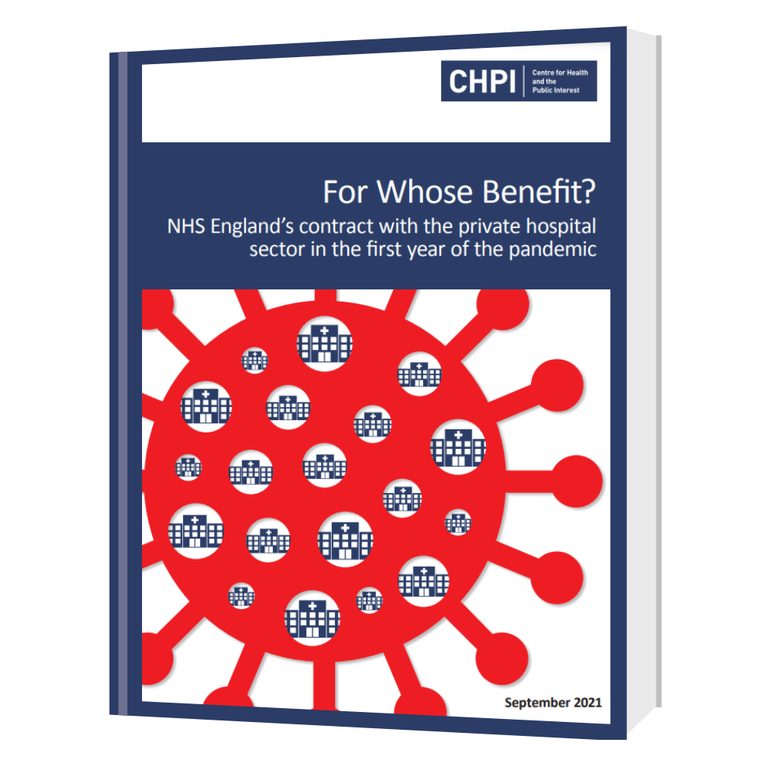
For Whose Benefit? — CHPI, September 2021
Other CHPI work
Other work has looked at the impact of acute inflation on PFI contracts, the rules — or lack thereof — around joint ownership between clinicians and private healthcare providers, and qualitative research on the break-up of Public Health England.
Out of Sight: understanding the hidden impact of cataract outsourcing on NHS finances
CHPI, March 2024. With David Rowland.
Built from data supplied by all 42 NHS Integrated Care Boards in England. The private sector’s share of NHS cataract operations rose from 24% in 2018/19 to 55% in 2022/23, at a cost of around £700m, while “complex” cataracts — which pay more — rose 144% in five years, almost entirely in private clinics. NHS England has said the increase cannot be explained by patients getting more complex.
P.F.I. Profiting from Inflation?
CHPI, October 2023. With David Rowland.
PFI payments are in many cases contractually pegged to RPI, so the 2022–24 inflation spike went straight onto NHS Trusts’ bills — an estimated £470m a year extra. Across 99 NHS PFI companies between 2004 and 2021: £28.4bn of turnover, £1.9bn of pre-tax profit, £1.07bn paid out in dividends and £47.6m in directors’ fees.
After the pandemic: is the new public health system in England fit for purpose?
CHPI, June 2023. With David Rowland. Funded by the Joseph Rowntree Charitable Trust.
Public Health England was abolished mid-pandemic and replaced by UKHSA and OHID, with no formal consultation and little parliamentary scrutiny. We surveyed 57 local Directors of Public Health — about half of those in post — and interviewed eleven. Before the reorganisation, 85% were clear about who took decisions nationally; afterwards, nearly half were not. Half thought the changes had left the country worse prepared for the next emergency.
Bailed out and burned out? The financial impact of COVID-19 on UK care homes for older people and their workforce
CHPI, April 2023. With David Rowland. A two-year study with Warwick Business School and UCL, funded by the ESRC.
Without £2bn of emergency government support, the care home sector would in all likelihood have collapsed financially in the first year of the pandemic. A quarter of companies increased their dividends over the same period, by 11%. Four in ten care staff reported money problems arising from working through it. Based on hundreds of company accounts, staff interviews and a survey of over 600 care workers.
Mapping joint venture businesses in private healthcare
CHPI, January 2022. With David Rowland.
Companies House filings and Competition and Markets Authority transparency data for 28 private healthcare companies, mapped against the consultants who part-own them. We identified 481 medical consultants holding equity in 34 joint ventures with private hospital companies; 73% of them were directly employed by the NHS. Over 2015–2020 those ventures turned over £1.24bn, recorded £258m of operating profit, and returned an estimated £31.3m to the consultants themselves. We also found NHS Trusts paying companies part-owned by their own consultants.
Five reports, five different registries — Companies House, the CMA, Hospital Episode Statistics, Integrated Care Board returns, a survey of Directors of Public Health. The subject changes; the method doesn’t.
Bristol Cable and local government
Before the health policy work I reported on local government in Bristol, for the Bristol Cable — an investigative local news co-operative owned by thousands of its readers. My bylines there run from November 2015 to October 2017 and are collected on my author page. The Cable’s own standfirsts of the period introduce me as its council correspondent.
It was, as much as anything, an education in what a small newsroom can and cannot do — where the money comes from, what you can afford to chase, and how long you can afford to chase it for.
Some of the work:
- Help! Help! To Southmead Hospital (via Guernsey) (November 2015) — Bristol has one of the largest PFI hospitals in the country. What PFI is, how it works, and how you go about finding out more. The start of the thread that runs through everything above.
- Carillion’s Southmead secrets (August 2016) — the state of a long-running Freedom of Information battle to establish how Southmead ends up costing over a billion pounds. Bridges directly to the FOI page.
- Bristol in the Panama Papers (July 2016, with Alec Saelens and Lucas Batt) — how offshore finance reaches down to a single city.
- Bristol Council to axe 1,000 staff (August 2016) — a sixth of the council workforce offered voluntary redundancy against a £43m budget gap.
- The sinkhole beneath our schools (November 2016) — Bristol’s schools estate and the optimistic PFI contracts holding it up.
- Exclusive: Fracking protections at port not as claimed by former mayor and council (October 2016, with Adam Cantwell-Corn and Alec Saelens) — what the safeguards on the Bristol Port sell-off actually said.
- Notes from City Hall: Power to the people? (June 2016) and Metro mayor: Is Bristol ready for devolution? (April 2017) — the billion-pound devolution deal, and the new office it created.
- Data leaves Bristol, dark ads arrive: how microtargeting is changing elections (July 2017, with Lucas Batt) — sponsored political advertising, and who was supposed to be watching it.
- The NHS is in ‘a desperate state’, can it be saved? (March 2017) and No more National Health Service (January 2017) — long-reads on Sustainability and Transformation Plans and the state of local services.
- NHS cuts hit fertility treatments (October 2017) — IVF eligibility narrowed at the same moment the Bristol Centre for Reproductive Medicine was privatised.
- Blowing the whistle, without getting whacked (November 2016) — written to launch the Cable’s journalist training programme. Sits alongside the tutoring page.