PFI
This story began when my mum sent me an item from the local news, ‘Hereford County Hospital Fails Fire Safety Test’. If I’d have known it would take six years to really understand why, I might have chosen something else for my MA Investigative Journalism dissertation.
It took five years to plan the contract for Wye Valley NHS Trust’s new hospital. Signed in 1999, it was in one of the first waves of Private Finance Initiative procurement. For a capital cost of £70m to build the thing, the Trust would be paying off £257m over the next 35 years, bundling up all its ancillary services to sweeten the pot for the private consortium. For that money, Hereford got a hospital with 30% fewer beds than the 350 it needed, running costs that would balloon to 10% of total turnover, and decades of price-gouging and cost-cutting across every outsourced service. All of this was justified on some ludicrous financial savings, impossible patient-flow targets, and not thinking too carefully about population growth or Hereford’s elderly demographics.
But what was worse is that the PFI consortium, Mercia Healthcare, was hiding a secret. Throughout the walls of any large public building there are fire barriers, an impermeable block on any fire spreading across the building during an emergency. But in Hereford hospital the fire barrier walls were riddled with defects: gaps, cracks, unprotected ductwork and unsealed cables drilled through the walls. Any one of these defects could mean the 30 minutes staff have to evacuate patients is cut down to two minutes, and there were hundreds of them. Most had been present since the first construction; maintenance and audit teams had somehow missed this for several decades, while adding several more along the way. And in 2012 it all started to come out.
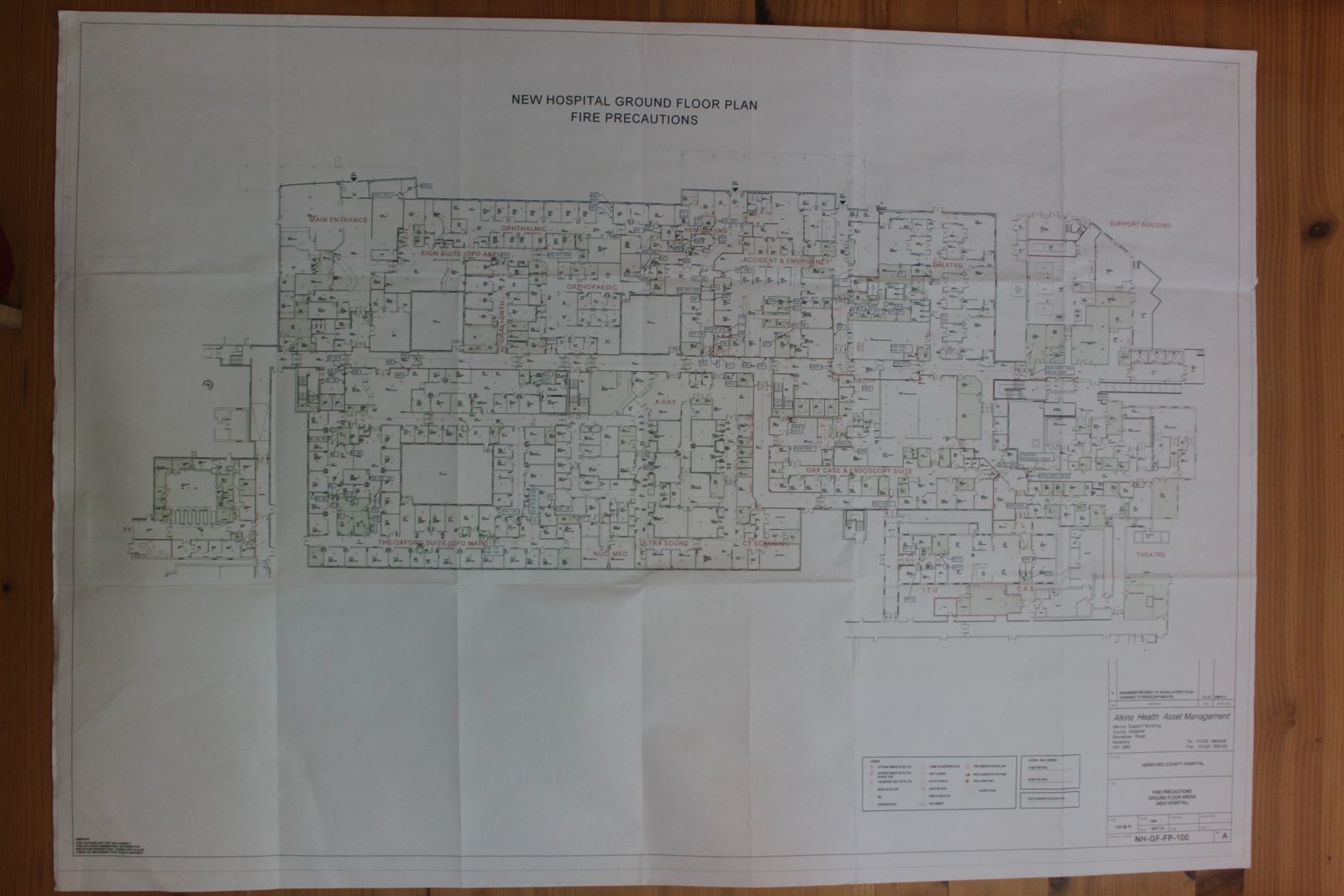
But all I had to start with was that local newspaper article, and the Fire Safety Notice it was based on. It said a safety test failed, but I needed to know why, who was responsible and who would be paying for it. But the world of private finance is famously opaque, and litigious, so I had my work cut out for me.
So I read every public document I could find about it: every quarterly board meeting, every set of company accounts, all the news clippings and anything I could scrape together from the web for the 15 or so years this hospital contract had been in development. The only records of the Business Cases for PFI contracts were the ones Allyson Pollock and her colleagues (who’d been calling PFI out all along) had diligently filed away in the 90s, so I took my hand-scanner and examined how the lofty ideals of the Outline Business Case were chiselled away and costed up to wind up with the grim reality of the 1999 Full Business Case.
So when I called up the CEO from the time and the Trust’s old operations manager I knew what I was talking about, and it would be
NEEDED — your call on the capital cost and contract term: this draft has £70m over 35 years, while the Research page has £75m over 30 years ending 2029.Gordon Brown, in a 2004 Radio 4 interview, on the appeal of an NHS PFI contract to investors: “…core services which the government is statutorily bound to provide, and for which demand is virtually insatiable. Your revenue stream is ultimately backed by Government. Where else can you get a business opportunity like that?”
…and it would be a very different conversation from the one they were expecting.
Jeremy Millar had been Chief Executive of Hereford Hospitals Trust through the 90s, when the deal was put together. He did not defend it so much as explain the trap. “I don’t think anyone on the board thought it was an ideal way to spend our time and energy, but it was our responsibility to the people of Hereford to build a new hospital, so we did what we had to do.” The three old hospitals were genuinely failing. A new one was genuinely needed. PFI was the only route to capital anyone was offering. What he said next is the part I keep coming back to: “The game we were then into was making the PFI programme economically viable against something that wouldn’t ever happen.”
That “something that wouldn’t ever happen” was the public sector comparator: the notional cost of building the hospital with public money, the benchmark PFI had to beat. Mike Johnson, the Trust’s Director of Contracts and Information and the man who carried most of the work, was blunter about how the numbers came out where they needed to come out. “We were all driven by an element of ‘this is the figure we want in this box here. We don’t care how you get it but this is what we want’,” he told me, “but there was never any common sense test on it. If there had been, we’d have said that this thing isn’t going to be affordable in the long run.”
“The thing about the financial models the Treasury insisted were used to compare these projects is that you can get any answer you like out of them. It wasn’t a method for comparing projects, it was a tool for justifying what was already decided.”
Lucy Reynolds, chartered accountant and PFI researcher
The people who signed the contract, then, would talk. The people running it now would not. The Trust never agreed to an on-the-record interview, and never replied to even 10% of the questions I put to it about the performance of the contract. I was pointed at a former interim Chief Executive, who asked me why I wanted to hurt an organisation both my parents had worked in at a relatively senior level.
Eventually Semperian’s regional manager and the Trust’s estates manager agreed to meet me in the faded regency tea rooms of a local hotel. I took a family friend, a retired psychiatrist, as a second pair of ears. Every time I asked about the fire safety settlement, one of them would glance at the other and say the information “wasn’t in the public domain”. The official line was that there were “robust procedures and controls in place” — a line flatly contradicted by the Trust’s own health and safety reports, which were disclosed a month later. My friend’s summary on the way out was better than anything I wrote that week: “Mercia insisted that problems were not problems and facts were not facts.”
So the documents were going to have to come out the hard way.
I asked for the papers submitted to the dispute resolution procedure between the Trust and Mercia in July 2013. The Trust refused, citing the exemption for information held for the purposes of a formal inquiry. It refused again at internal review. The Information Commissioner ordered disclosure in September 2014. The Trust appealed to the First-tier Tribunal — a public body suing the regulator to keep a fire safety dispute private — and I joined the case as a party. Two hearing dates were set. A week before the second, in April 2015, the Trust withdrew. The documents arrived by post from its solicitors a fortnight later, roughly two years after the settlement they described.
What they showed was this. The Trust’s own investigation found the whole hospital riddled with faults: not a single fire compartment had ever met the construction standards the builders were obliged to meet, and the twice-yearly safety audits had never identified it. The company hired to investigate the building’s defects was the company that had built it. Mercia’s constituent companies did not attend meetings to discuss the problem, but assured the Trust an extensive survey had been done and there was nothing to worry about. When the Trust tried to withhold £7m of PFI payments — less than half of what Mercia takes in a year, but larger than any previous PFI dispute settlement in Britain — Mercia accused it of manufacturing the problem to plug a hole in its own finances, refused to share its reports, denied Trust officials access to parts of the hospital, and instructed its own repair team not to speak to them.
The Trust recovered £3.5m: about three months of unpaid PFI charges. No damages. No compensation for the decade in which the safety regime had not worked. The contract does not allow for it. And in settling, the Trust signed away its right to pursue the matter in court.
I wrote it all up. No publication would take it: the answers I got were “too complicated” and “PFI is boring”. That is most of the problem in one sentence. A single question in a local newspaper — why did the hospital fail a fire safety test — took six years, a dissertation, an ICO complaint, a tribunal I joined as a party and a second one I brought myself. The contract runs to 2029, and everything above is still true.
I kept going because the alternative was letting the reason it happened stay private, which was the whole design. And by the end of it I had learned the only skill that reliably gets these documents out, which is the one the rest of this site is mostly about.